Module 8 — Arrays, Loops, and Objects
Keep many values in one place, visit each one in turn, and give each item named facts.
Time: about 2.5 hours (estimate)
About this module
What this module covers
You learn to keep lists in arrays, visit every item with a loop, and give each item named facts with objects. It’s the toolkit for any page built from data: twenty projects or milestones don’t fit in twenty separate variables.
Tips for the learner
Some prompts ask you to explain code to yourself, out loud. Others ask you to write something down. Each habit does a different job.
Recite to understand. When a prompt says “out loud,” explain the code in your own words, as if you were teaching it. Saying it aloud makes a deeper impression than reading silently. It helps you picture how the pieces of code fit together. And it shows you right away which line you cannot explain yet. That line is the one to review.
Write it down to check yourself. When a prompt says “write down,” it is usually a prediction, a choice, or a guess about a bug. A written answer can’t change after you see the result, so the comparison is fair and you learn from the difference. Writing also keeps your attention on the lesson and helps you pick out the main points.
Keep one notebook for this course. Use it for your predictions, key terms, steps, mistakes, and questions to come back to. Date each entry and write the module number, so you can find it later. Before you start a new module, read your last few entries and recite one or two of them out loud.
The four badges
Every core concept moves through the same four steps, called IEIA. Each step is marked with its badge.
 - Introduce (a lightbulb: a new idea) - You meet the concept: its name, and why it matters to you, in a sentence or two.
 - Explain (a speech bubble: the idea in words) - How it works, one idea at a time, in plain words.
 - Illustrate (an eye: see it) - A small example you can look at: a code snippet, a real screenshot or a diagram. Its caption, which starts with this badge, tells you what to notice.
 - Apply (a keyboard: your turn) - A short task to do right now, before you read on. Often you type or predict something; sometimes you write it down, sketch it, or explain code to yourself out loud.
Contents
- Why this matters
- Before you start
- Core concepts
- 1. What is an array, and why does counting start at 0?
- 2. What does
.lengthtell you, and where is the last item? - 3. How do you add an item with
.push()? - 4. How does a
forloop visit every item? - 5. How do you use a condition inside a loop?
- 6. When should you use
for...ofinstead? - 7. How do
.includes()and.join()help? - 8. What is the difference between a property and a method?
- 9. What is an object?
- 10. When does an array of objects beat parallel arrays?
- 11. How do
&&,||and!combine true and false?
- Exercise
- Project (in the full packet)
- Common misconception
- Summary
- Check your understanding
- Before next module
- Go further
- What to keep
In this module you will learn:
- What an array is, and why its indexes start at 0
- How
.lengthworks, and why the last item is atlength - 1 - How to add an item to the end with
.push() - The traditional
forloop, and whati++does - How to put a condition inside a loop to count or pick items
- The
for...ofloop, for when you only need each item - How
.includes()checks arrays and strings, and how.join()turns an array into text - Properties versus methods:
object.propertyversusobject.method() - Objects as named bundles of properties, dot access, and arrays of objects
- When an array of objects beats several parallel arrays
- The logical operators
&&,||and!
Why this matters
A real site has several pages, several projects and several milestones. So far, every value in your JavaScript has lived in its own variable. That works for two or three values. It does not work for twenty, and it does not work when you do not know how many there will be.
This module gives you the three tools every data-driven page is built from. A data-driven page is a page built from data, such as a list of projects, and not typed out one item at a time. An array keeps a list in one variable. A loop visits every item in that list without you writing one line per item. An object gives each item named facts, like a title, a year and whether it is live. Put the three together and you have an array of objects, which is how most real web data is shaped.
You stay in the Console and Node one more time. In Module 9 you use the same patterns on a web page, where a loop over an array of objects builds a list a visitor can see.
Before you start
- Finish Module 7. You should be able to write a function with a parameter and a
return, and test it with several calls. - In your course folder, create a throwaway folder called
practice-08. - Open it in VS Code with File → Open Folder….
- Open a terminal with Terminal → New Terminal.
- Open Edge or Chrome. Press F12 (or Ctrl+Shift+J) to open DevTools, then click the Console tab.
- On paper, write down three of your own interests and two projects or milestones you would like on your site. You will use them instead of the examples.
Checkpoint. You have an empty
practice-08folder open in VS Code, a terminal whose prompt ends inpractice-08>, a Console ready, and your own short list on paper.
Core concepts
1. What is an array, and why does counting start at 0?
An array is one variable that holds a list of values, in order. You write it with square brackets and commas.
Each item has a position number called an index. The first index is 0, not 1. Think of the index as “how many steps from the start”: the first item is zero steps away. You read an item with the array name and the index in square brackets: pages[0].



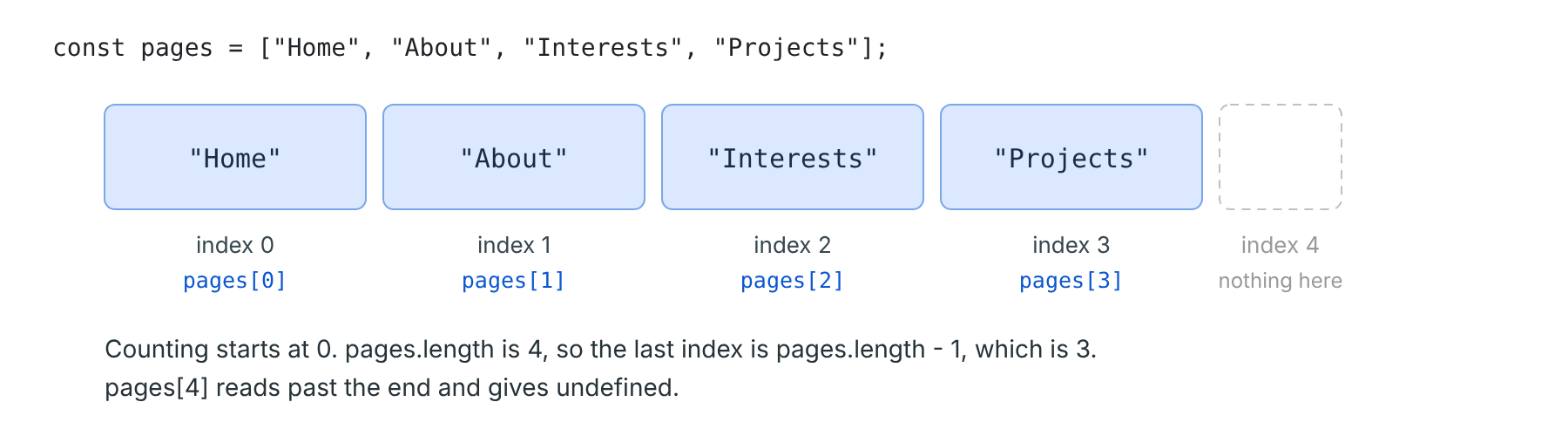
Four items, indexes 0 to 3. There is no index 4.
Before you type anything, think this through: what does pages[2] hold?
2. What does .length tell you, and where is the last item?
.length is the number of items in the array.
Because counting starts at 0, the last index is always one less than the length. That is why pages[pages.length - 1] always gives the last item, however long the list grows. Reading at an index that does not exist is not an error. You get undefined, quietly.
Typed into the Console for the picture below, in this order:
const pages = ["Home", "About", "Interests", "Projects"];
pages[0]
pages[3]
pages.length
pages[pages.length - 1]
pages[4]
pages.push("Contact")
pages
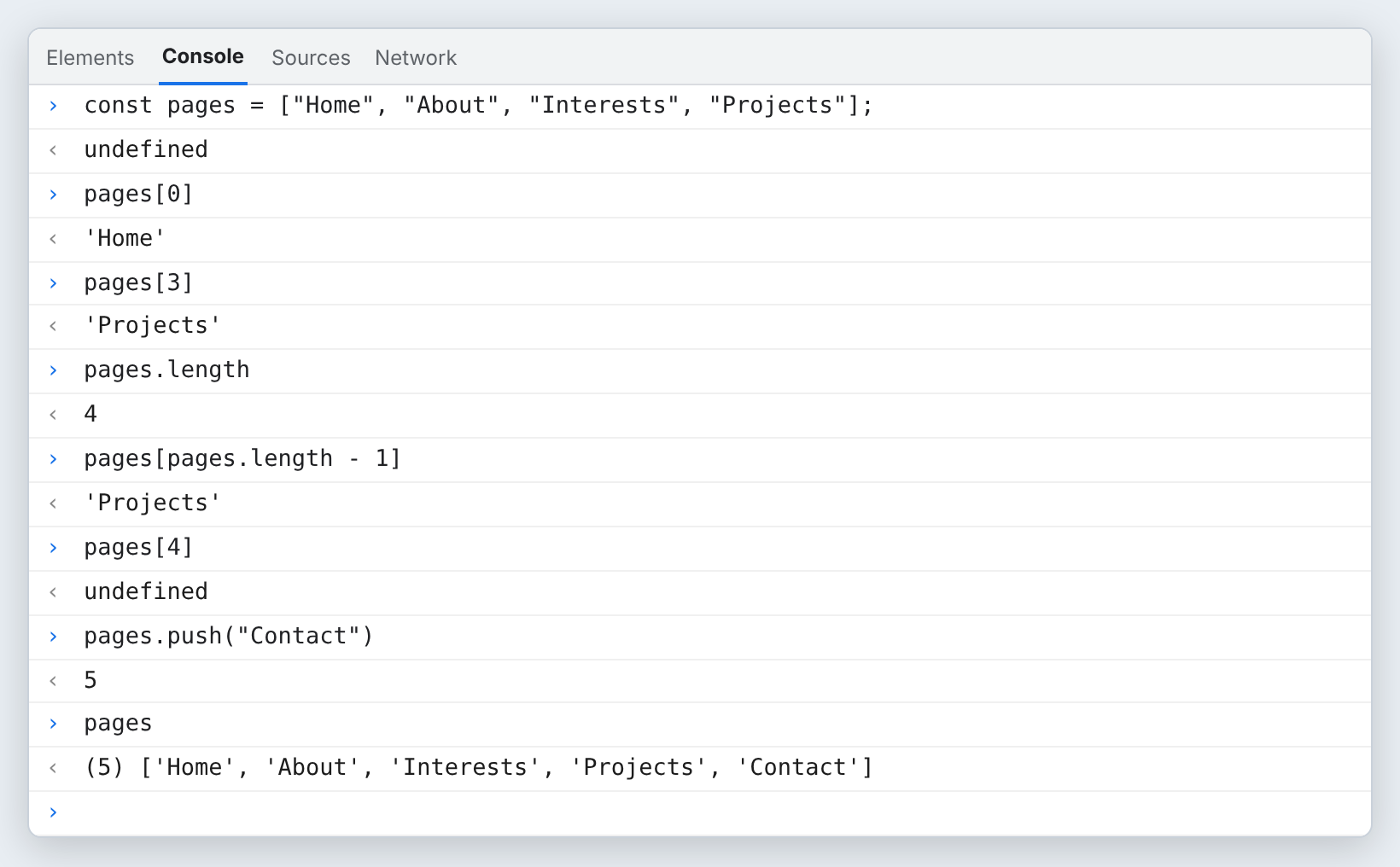
pages[4] gives undefined, not an error. Note what .push() prints: 5, the new length, not the array. (real output, rendered)
Type the pages array into your Console and read pages[pages.length]. Predict first. Why is it undefined?
3. How do you add an item with .push()?
.push() adds one or more items to the end of an array.
The array changes in place. That means the same array gets longer; no new array is made. The value .push() hands back is the new length (MDN, Array.prototype.push(): “The new length property of the object upon which the method was called”). So do not write pages = pages.push("Contact"). That would try to replace your array with a number. Just call pages.push("Contact") on its own line. This works even though pages was made with const, because const stops you pointing the name at a different array; it does not stop the array’s contents from changing.
In the image above, pages.push("Contact") printed 5, and the next line showed five items with 'Contact' at the end.
Push one of your own interests onto an array, then check .length went up by one.
4. How does a for loop visit every item?
A loop runs the same block of code again and again. Each run is called a lap, like one lap around a running track. The traditional for loop counts, so it is a natural fit for indexes.
The line for (let i = 0; i < pages.length; i++) has three parts between the parentheses, separated by semicolons. Start: let i = 0 runs once. Check: i < pages.length runs before every lap; while it is true, the body runs; when it is false, the loop stops. Step: i++ runs after every lap. ++ means “add 1 to this variable.” It is short for i = i + 1. Inside the body, pages[i] is the item for this lap.
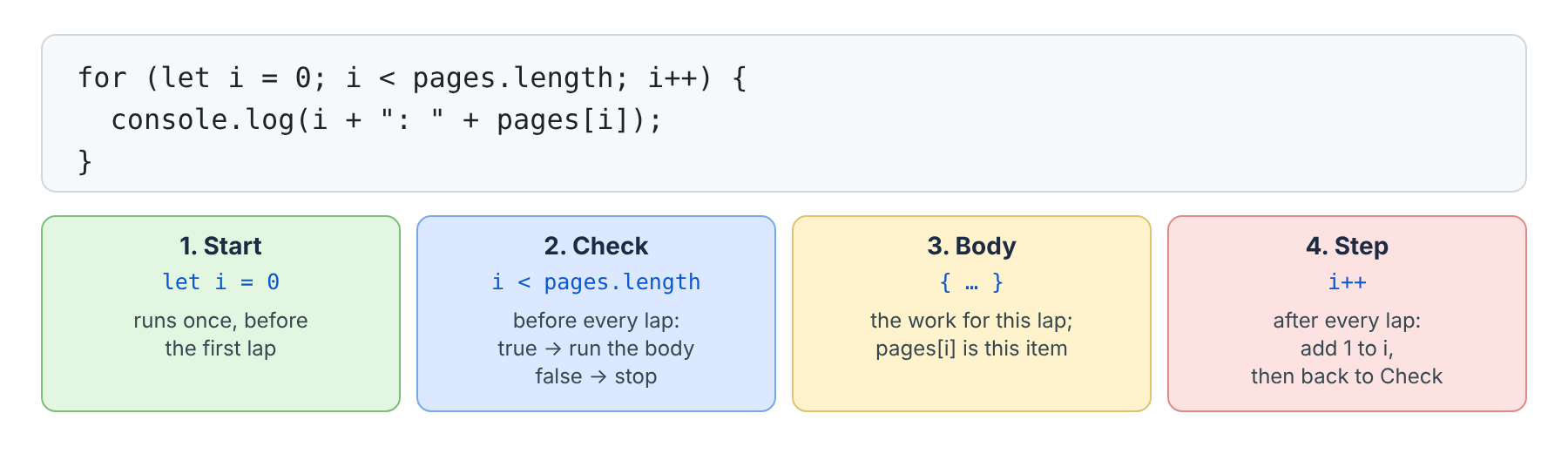
The check uses <, not <=. With 4 items, i takes the values 0, 1, 2 and 3, and the loop stops when i reaches 4.
Typed into the Console for the picture below, in this order. The first line makes a fresh four-item pages, without the "Contact" you pushed above. (The Console lets you type a const line again to start over; in a file, declaring the same name twice is an error.)
const pages = ["Home", "About", "Interests", "Projects"];
for (let i = 0; i < pages.length; i++) {
  console.log(i + ": " + pages[i]);
}
let count = 0;
count++
count
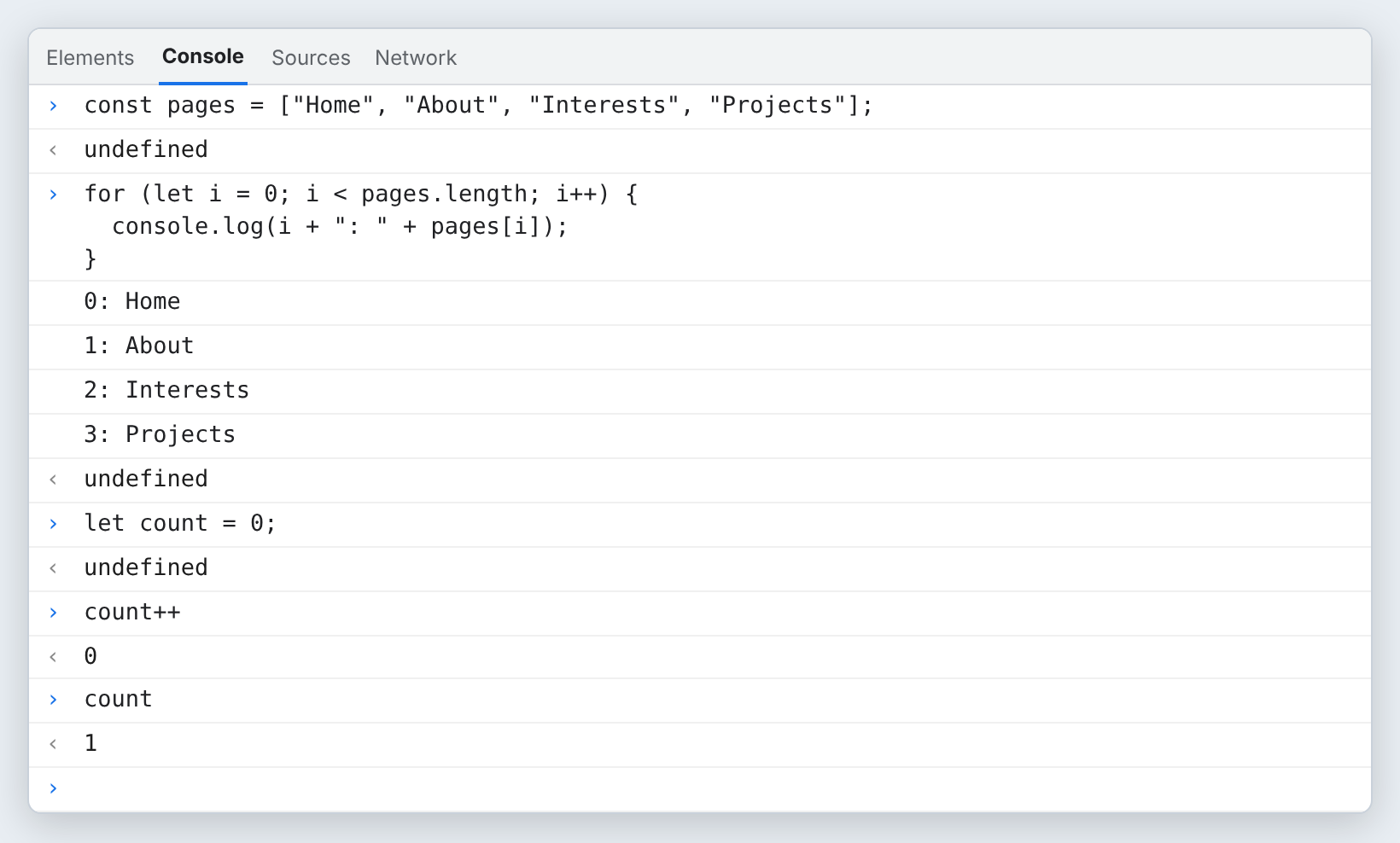
Four laps, four lines. At the bottom, count++ shows 0 because it hands back the old value and then adds 1. Asking for count on the next line shows the 1. Inside a loop you never use that handed-back value, so it does not matter there. (real output, rendered)
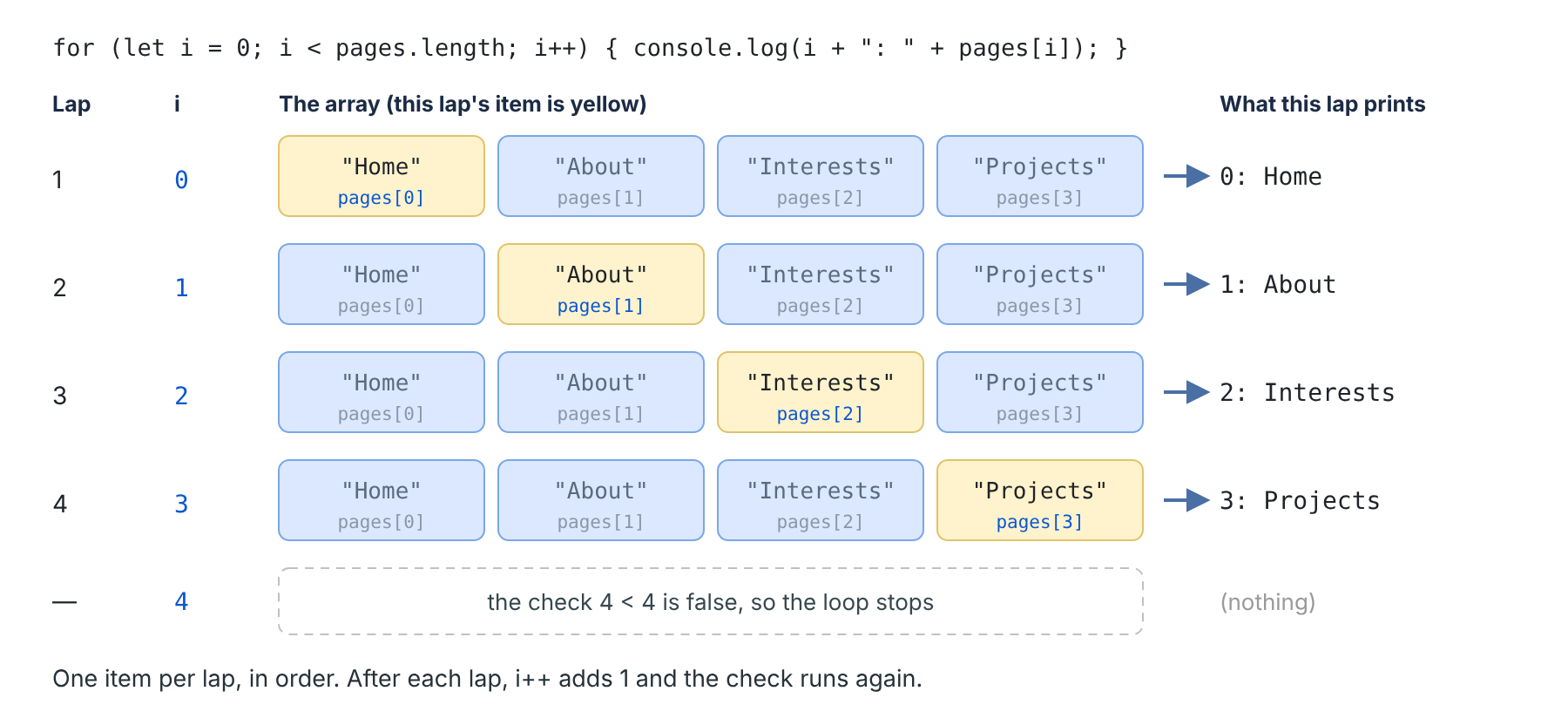
The same loop, drawn lap by lap. One item is handled per lap, in order, and i is the index of that item. When i reaches 4 the check fails, so there is no fifth lap.
Change i < pages.length to i < 2 and predict how many lines print.
5. How do you use a condition inside a loop?
Put an if inside the loop body, and the loop can count or pick only some items.
The pattern is: make a counter (a variable that holds a running count, starting at 0) before the loop, check each item inside the loop, and add to the counter when the check is true. After the loop, the counter holds the answer. You used if in Module 6; nothing about it changes inside a loop.
Typed into the Console for the picture below, in this order. (In the picture, let restDays = 0; and the loop were typed as one entry. If you type them one at a time, you see one extra undefined after the first line.)
const minutes = [30, 0, 45, 20, 0];
let restDays = 0;
for (let i = 0; i < minutes.length; i++) {
  if (minutes[i] === 0) {
    restDays++;
  }
}
restDays
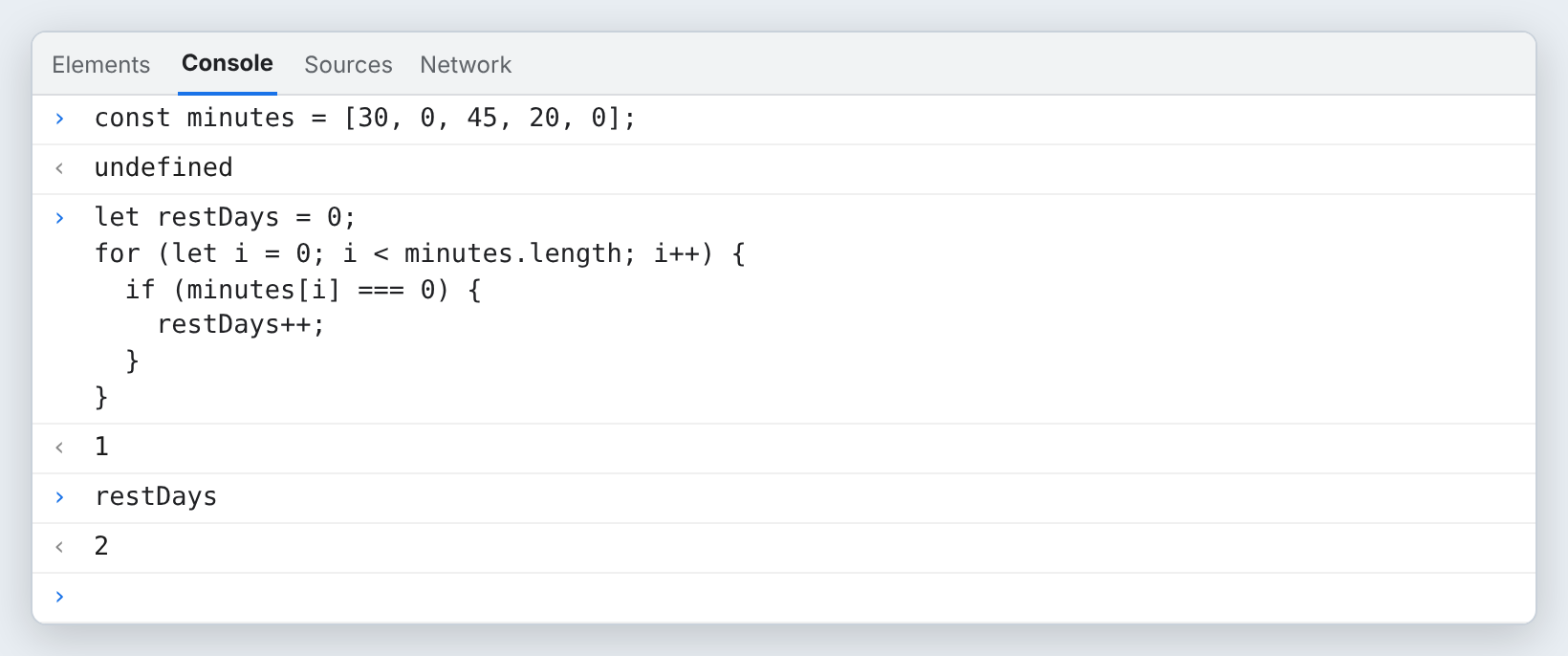
An array of practice minutes is checked day by day, and every 0 adds one to restDays. The answer is 2. The 1 right after the loop is not the answer: after any loop, the Console also shows a value left over from the last lap, often undefined. To see the answer, ask for the variable, as on the next line. (real output, rendered)
Change the check to minutes[i] >= 30 and the name to longDays. Predict the answer before you run it. (It is 2: the 30 and the 45.)
6. When should you use for...of instead?
for...of is a second kind of loop. On an array, it runs one lap per item, in order, and puts the item itself in a variable for you.
for (const amount of minutes) gives you each value directly, with no i and no square brackets. Use it when you only need the items. Use the counting for loop when you also need the position, for example to print 1:, 2:, 3: beside each one.
Typed into the Console for the picture below, in this order, right after the Concept 5 lines (so minutes already exists):
for (const amount of minutes) {
  console.log(amount + " min");
}
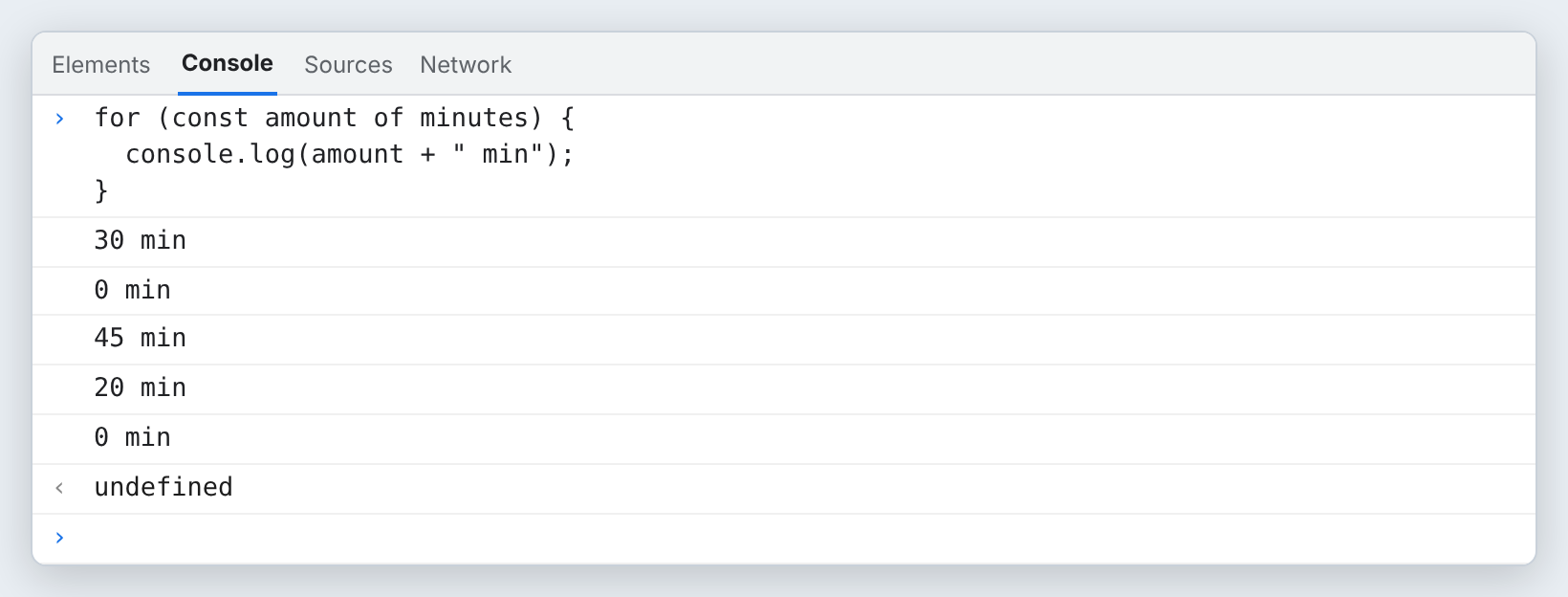
for...of visits the same five values as the counting loop in Concept 5, with less to type. The undefined at the end is the value left over from the last lap, as in Concept 5. (real output, rendered)
Rewrite the rest-day counter with for...of. You need if (amount === 0) inside.
7. How do .includes() and .join() help?
.includes() answers “is this in here?” with true or false. .join() turns an array into one piece of text.
.includes() works on arrays and on strings. On an array, it checks whole items. On a string, it checks for a piece of text anywhere inside. It is exact: "Music" and "music" are different. .join() puts the text you give it between items. That text is called the separator. With nothing in the parentheses, MDN says the items “are separated with a comma.”
Typed into the Console for the picture below, in this order:
const interests = ["drawing", "cycling", "music"];
interests.includes("music")
interests.includes("Music")
"front-end developer".includes("end")
interests.join(", ")
interests.join()
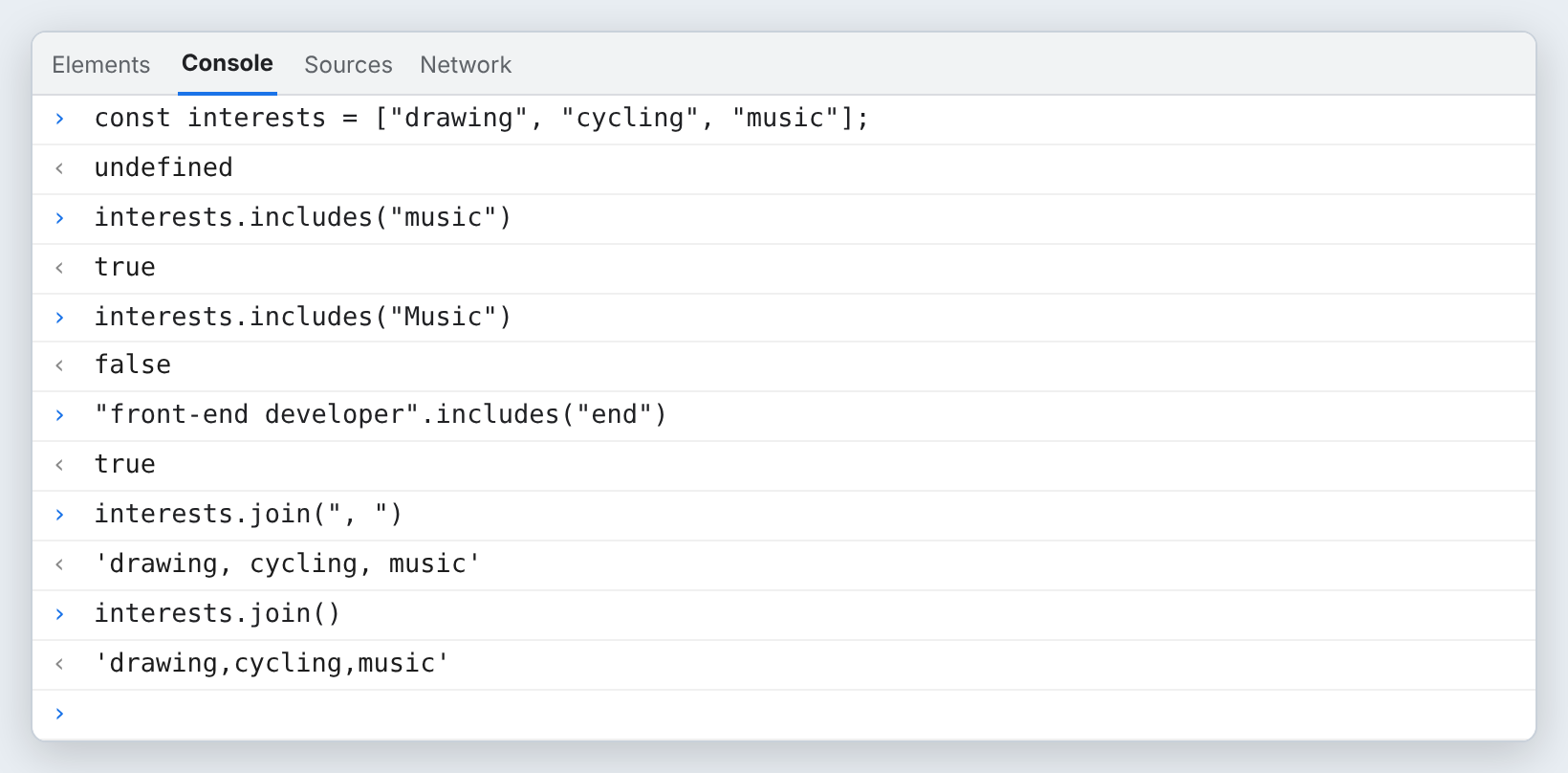
Capital letters matter to .includes(). And notice the difference between join(", ") and join(): the space after the comma only appears when you ask for it. (real output, rendered)
Join your own interests with " / " and with " and ". Which reads better as a sentence?
8. What is the difference between a property and a method?
Arrays and strings carry named values you can read, and named actions you can run. A value is a property. An action is a method.
You read a property with a dot and its name: tags.length. You run a method with a dot, its name and parentheses: tags.push("js"), " hello ".trim(). MDN’s glossary defines a method as “a function which is a property of an object.” So this is Module 7 again: a method name without parentheses is a reference to the function; with parentheses it is a call. Put parentheses on a property and JavaScript throws a TypeError: it stops with that error, the same kind you met in Module 6. .trim() returns a copy of the string without the spaces at both ends; you will lean on it in Module 10 to check form inputs.
Typed into the Console for the picture below, in this order (two spaces before and after hello):
const tags = ["html", "css"];
tags.length
tags.push("js")
tags.length
tags.length()
"  hello  ".length
"  hello  ".trim()
"  hello  ".trim().length
"hello".trim
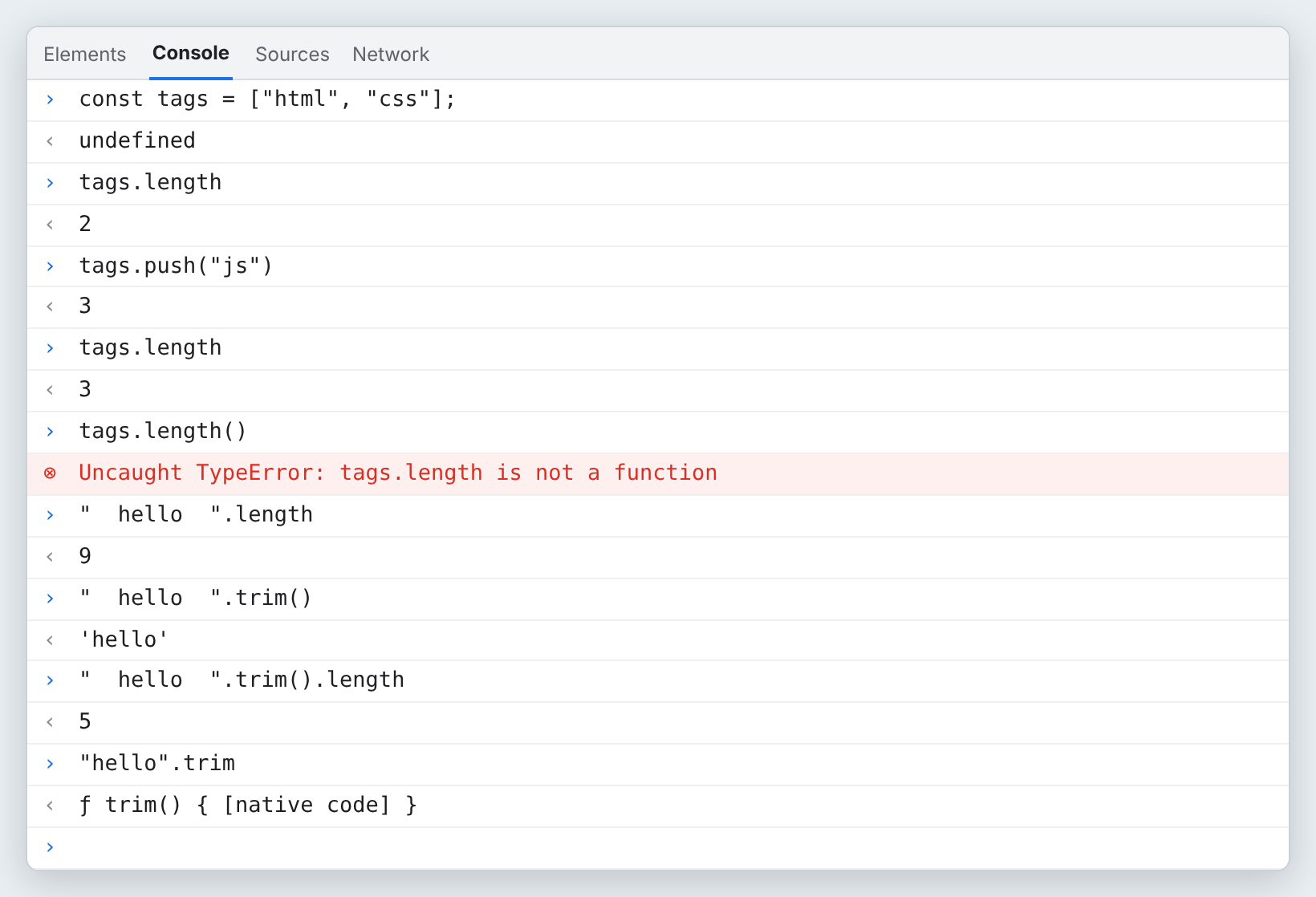
Parentheses on a property are an error, because a number cannot be run. A method without parentheses gives you the function itself, the same thing you saw with showMessage in Module 7. (real output, rendered)
For each of these, say “property” or “method” to yourself, out loud, before you type it:1 pages.length, pages.push("Blog"), "Hi ".trim(), "Hi ".length.
9. What is an object?
An object is a named bundle of properties. Where an array is a list in order, an object is a set of labeled facts about one thing.
You write an object with curly braces. Each property is a name, a colon and a value, separated by commas: { title: "Rating card", year: 2026, live: true, tags: ["html", "css"] }. You read a property with a dot: project.title. This is called dot access. A value can be anything, including an array, so project.tags.length reads the length of the array stored in tags. Asking for a property that does not exist gives undefined, just like reading past the end of an array.
Typed into the Console for the picture below, in this order:
const project = { title: "Rating card", year: 2026, live: true, tags: ["html", "css"] };
project.title
project.tags.length
project.status
const projects = [
  { title: "Rating card", year: 2026, live: true },
  { title: "FAQ card", year: 2026, live: false }
];
projects[1].title
for (const p of projects) {
  console.log(p.title + " (" + p.year + ")");
}
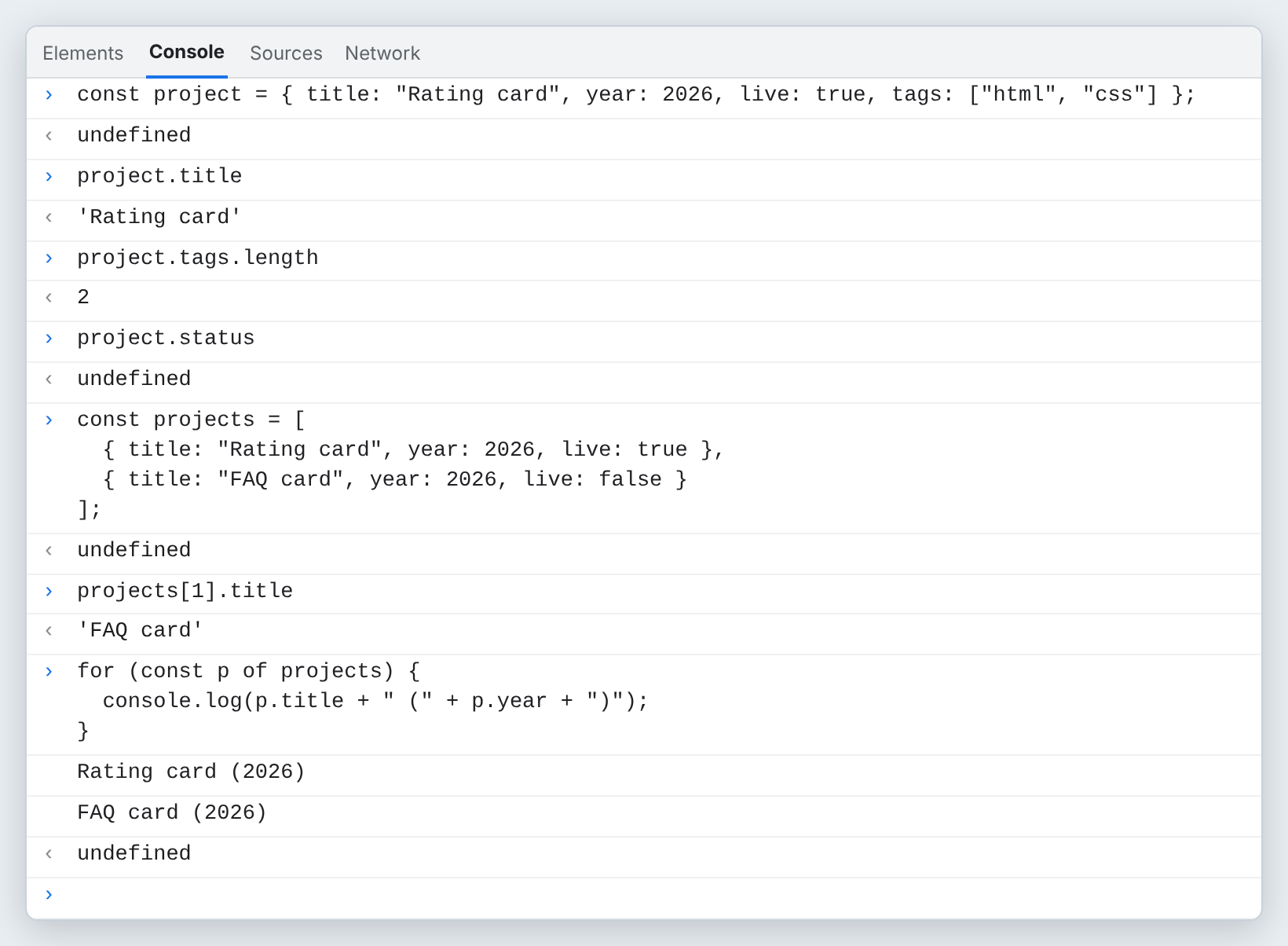
projects[1].title reads from left to right: the array, then item 1, then its title. The loop at the bottom visits each object and reads two of its properties. (real output, rendered)
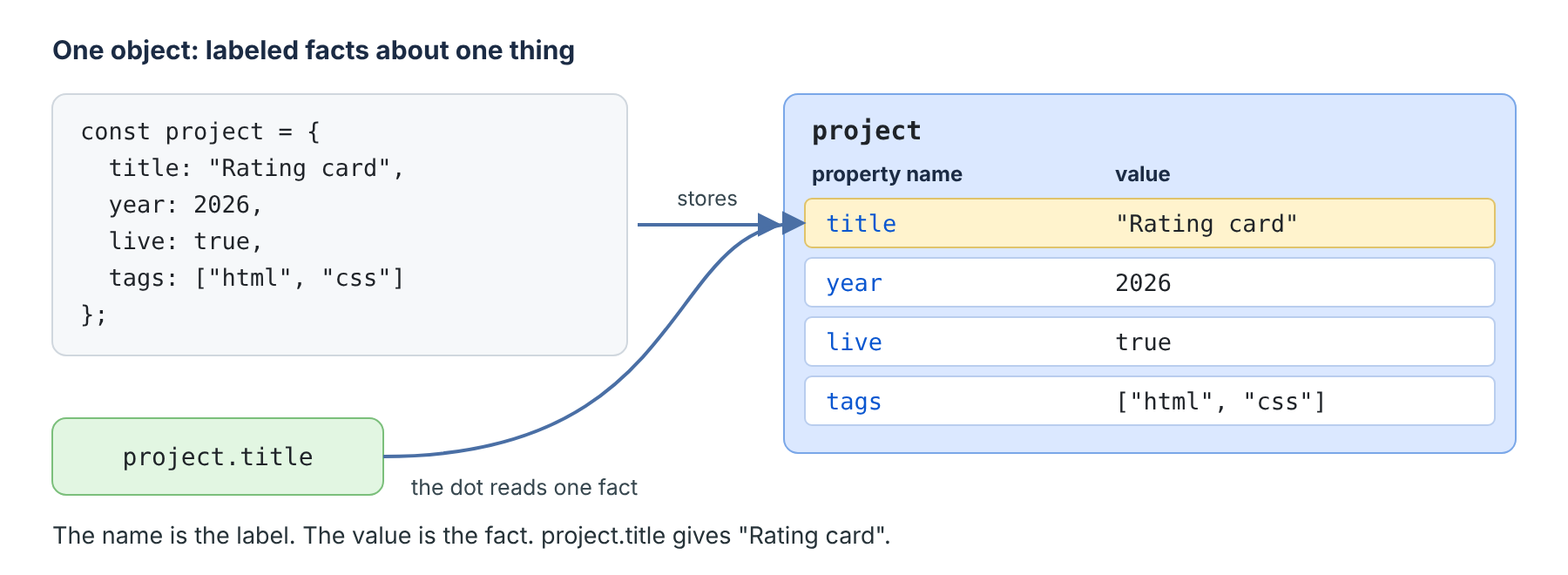
One object keeps related facts together. Each property name is a label, and its value is the fact. project.title uses the label to read one fact.
Make an object for one of your own projects or milestones, with at least a title and a year. Read each property back.
10. When does an array of objects beat parallel arrays?
Parallel arrays are several arrays where item 0 of each belongs together, item 1 of each belongs together, and so on.
They work until something changes. Delete an item from one array and forget the other, and every item after it is paired with the wrong facts, with no error to warn you. An array of objects keeps each item’s facts together, so they cannot drift apart. Use an array of objects whenever each item has two or more facts.
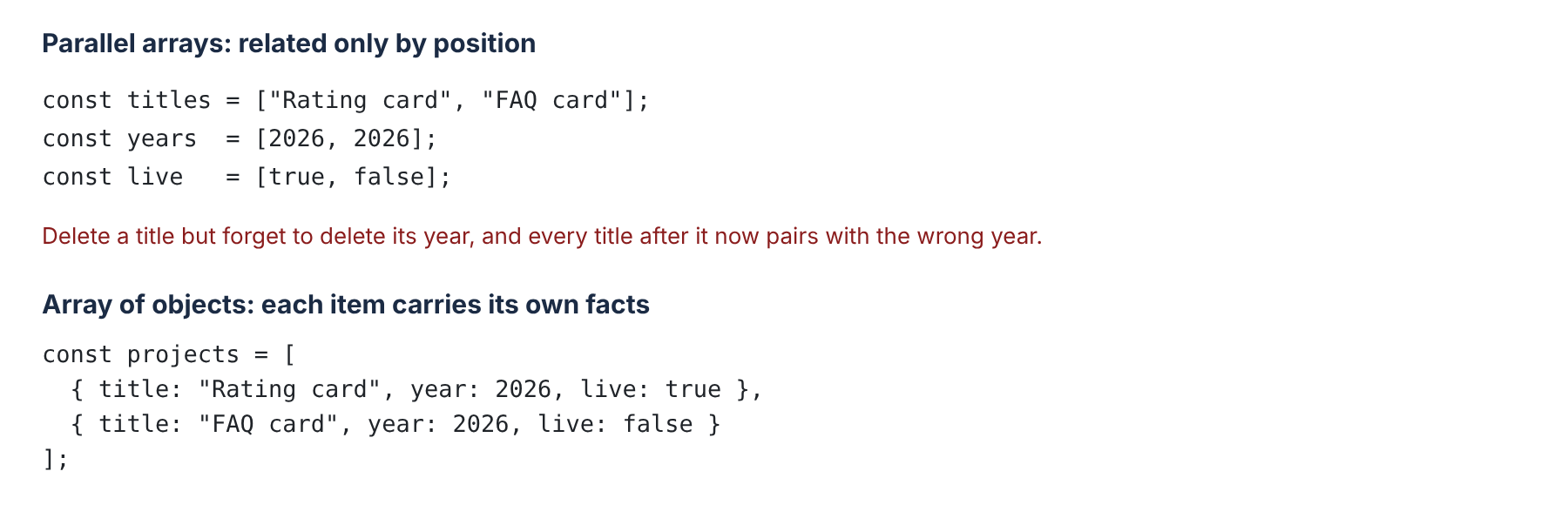
The same two projects, stored two ways. In the bottom version, adding a fact means adding one property, not a whole new array.
Take your paper list of projects or milestones and write it as an array of objects.
11. How do &&, || and ! combine true and false?
A change of topic for the last concept: it is not about arrays, but the Exercise needs it to check two facts about each place at once.
Logical operators join two checks into one, or flip one.
&& (AND) is true only when both sides are true. || (OR) is true when at least one side is true. ! (NOT) flips true to false and false to true. You will use them in if statements, such as “the project is live AND it is from this year.” MDN adds one detail: with values that are not true or false, these operators hand back one of the values themselves (for example, "Home" && "About" gives 'About'). In this course you will use them with true and false.
Typed into the Console for the picture below, in this order:
[true && true, true && false, false && true, false && false]
[true || true, true || false, false || true, false || false]
[!true, !false]
const live = true;
const year = 2025;
live && year === 2026
live || year === 2026
!live
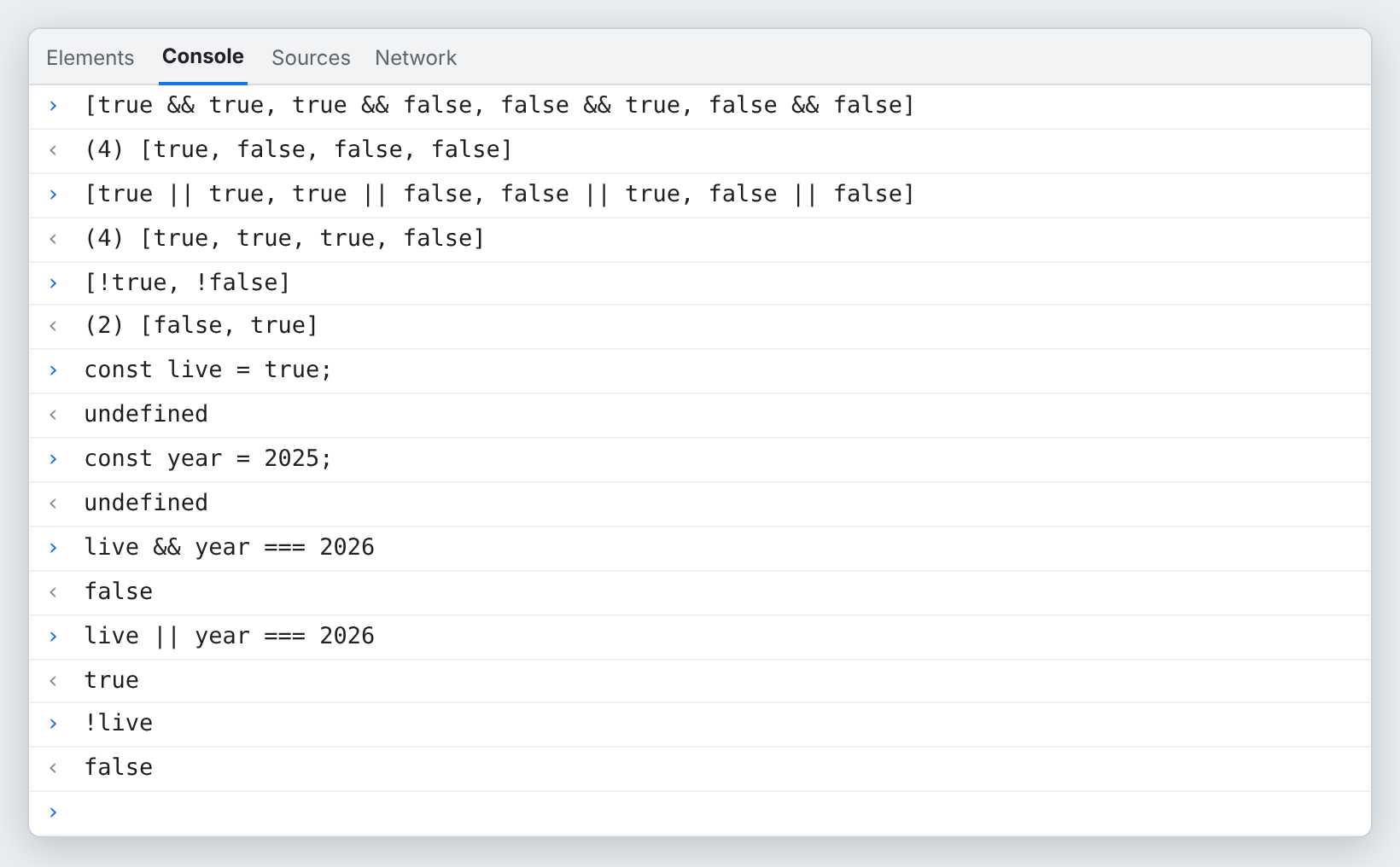
The first three lines are the full truth tables. Only one && row is true; only one || row is false. Then a real use: year === 2026 is false, so the && fails and the || passes. (real output, rendered)
Predict !live && year === 2025, then type it to check.
Exercise
Your hands, about 50 minutes (estimate). Type it, do not paste it. Work in practice-08. Use your own interests and places instead of the examples if you like; the shape is what matters.
-
Create
practice.js. -
In it, type an array of three interests named
interests, for exampleconst interests = ["drawing", "cycling", "music"];. -
Below it, log its
.lengthand its last item usinglength - 1. -
Push one more interest with
.push(). -
Loop with indexes. Write a
forloop that logs each item with its index in front, like0: drawing. -
Check and join. Log
interests.includes(…)for one item you have and one you do not. -
Then log
interests.join(" | "). -
An array of objects. Type this, with your own place names if you prefer:
const places = [ { name: "City library", visited: true, free: true }, { name: "Art museum", visited: false, free: false }, { name: "River park", visited: false, free: true } ]; for (const place of places) { if (!place.visited && place.free) { console.log("Next free trip: " + place.name); } } -
Read the
ifto yourself, out loud, before you run it: “not visited, and free.” -
Run it. First, predict every line the file will print.
-
Save, then type
node practice.jsin the terminal. With the example data you should get 10 lines, ending inNext free trip: River park. -
Break it on purpose. In the
forloop from step 5, changei < interests.lengthtoi <= interests.length. -
Save and run.
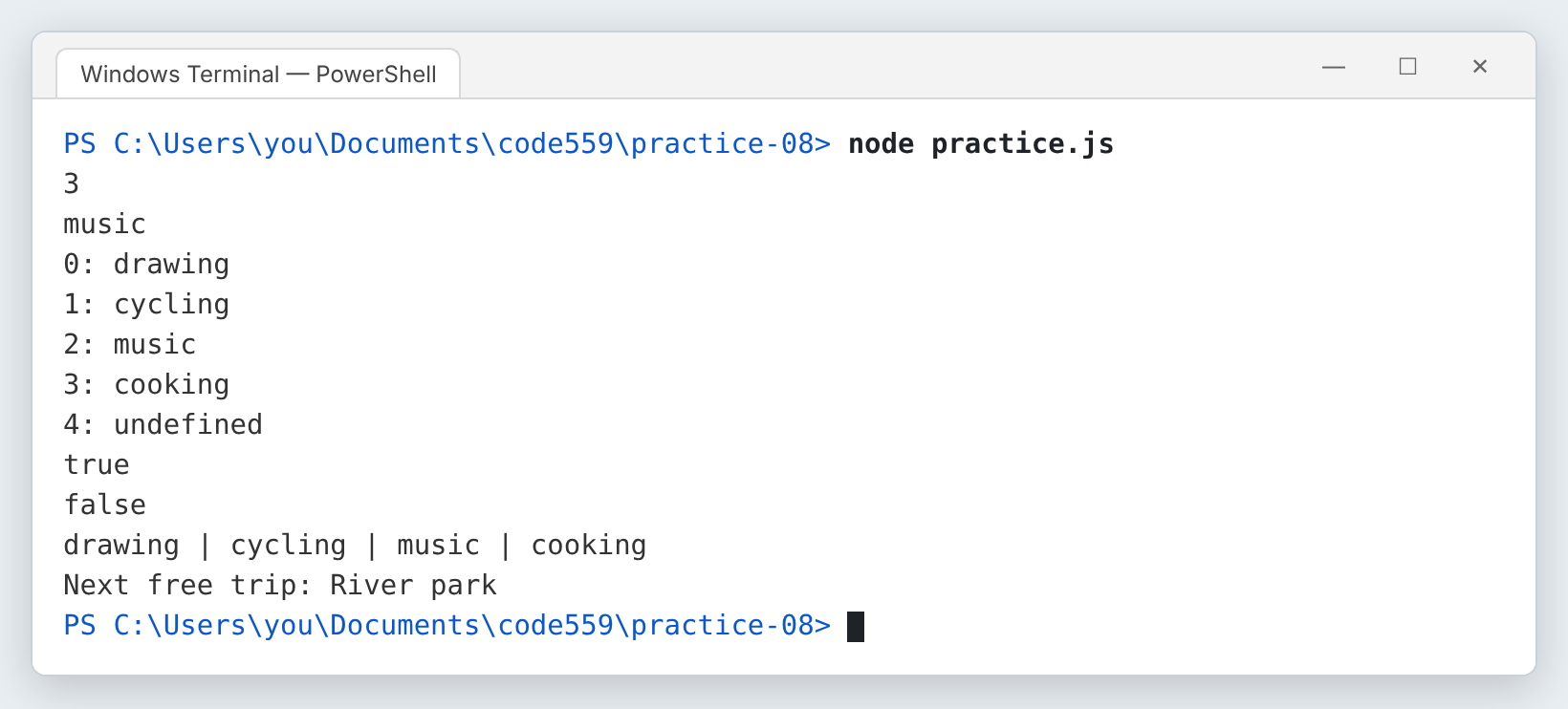
One character added, one extra lap. On the last lap
iis 4, which equals the length, andinterests[4]isundefined. No error message, just a wrong line. This is called an off-by-one error. (real output, rendered; captured on Linux, with the folder path changed to the course folder) -
Change
<=back to<, run again, and check theundefinedline is gone. -
Your own. Below everything, write a loop that counts how many places are
freeand logs the count. With the example data, the answer is 2. -
Modify. Change the
ifin step 8 from&&to||. -
Predict which places print now, then run it.
Project (in the full packet)
The project is a site-data.js file for your personal site: your real Projects and Milestones written as two arrays of objects (each with a title, year and short description; projects also have tags and whether each one is live), plus a few small functions that summarize the data, written from one-sentence descriptions and tested in Node. One counts the live projects, one lists every title as a single line of text, and one collects the milestones from a given year. In Module 9 you use the same patterns on a web page, building a list from an array of objects.
The full brief, the step-by-step build, and the finishing work in Git are in the Module 8 packet. Get the packet → (opens in a new tab)
Common misconception
“An array with 4 items ends at index 4.”
What would you say? Hint: look at what pages[4] printed in the Concept 2 image, and count how many steps the first item is from the start.
Summary
An array keeps a list of values in order, and its first index is 0. .length is the number of items, so the last item is at length - 1, and reading past the end gives undefined. .push() adds to the end and hands back the new length. The traditional for loop has a start, a check and a step, and i++ adds 1 to i after every lap. An if inside a loop lets you count or pick items. for...of gives you each item directly when you do not need its index. .includes() answers true or false for arrays and strings, exactly, and .join() turns an array into text with the separator you choose. A property is a value you read with object.property; a method is an action you run with object.method(). An object is a named bundle of properties read with dot access, and an array of objects keeps each item’s facts together where parallel arrays can drift apart. && needs both sides true, || needs one, and ! flips a value.
Check your understanding
tags.length()throws aTypeError, buttags.push("js")works. Why does one need parentheses and the other must not have them?- You have six projects in an array. Which index holds the last one, and how would you write that so it still works when you add a seventh?
- What value does this variable hold after this code runs?
let n = 0; for (const p of places) { if (p.visited || p.free) { n++; } }(use the three places from the Exercise)
Before next module
You should now be able to do these on your own:
-
practice.jsruns withnode practice.jsand every line matches your predictions - You saw the extra
undefinedline from<=and fixed it - You can say, for
.length,.push()and.trim(), which is a property and which are methods - Your own projects or milestones are written on paper (or in a file) as an array of objects
- If you did this module’s packet project in my-site, saved it with the routine: git status → git add . → git commit -m “…” → git push → check the live page. (Your practice folder is not saved to GitHub.)
You have only been introduced to these so far:
.trim(). You saw it in Concept 8 only. Module 10 uses it for real, to check form inputs.- An array stored inside an object, as in
project.tags.length. You read one in Concept 9; the Exercise did not use one. - Parallel arrays. You saw why they drift apart, but you did not build any.
- What
&&and||hand back when the values are nottrueorfalse. This course uses them withtrueandfalseonly. - Building a list on a web page from an array of objects. Module 9 does it for real.
Go further
- MDN: Array.prototype.push(), Array.prototype.includes(), Array.prototype.join()
- MDN: for…of; the for statement, for the counting loop; and Loops and iteration (the JavaScript Guide page)
- MDN: JavaScript object basics and Working with objects
- MDN: Logical AND (&&), and the matching Logical OR (||) and Logical NOT (!) pages
- MDN Glossary: Method; and String.prototype.trim()
- freeCodeCamp: the free JavaScript Certification (checked 2026-10-11) has practice on this topic.
What to keep
Keep practice.js and your array of objects for your own projects or milestones; the Module 8 project starts from it. Then answer for yourself: which step would be hardest to repeat without this post, and why?
Code559 is a 559 Solutions project. Portions adapted from Visual Studio Code documentation (CC BY 3.0 US), GitHub Docs (CC BY 4.0), and GitHub Skills (MIT). Screenshots used with permission from Microsoft.
Sources checked 2026-10-09: MDN “Array.prototype.push()”; MDN “Array.prototype.includes()”; MDN “Array.prototype.join()”; MDN “for…of”; MDN “Logical AND (&&)”; MDN Glossary “Method”; MDN “String.prototype.trim()”; Chromium (via Playwright) for every Console result; Node 22.22.0 for every terminal result. Checked 2026-10-11: MDN “for…of” (plain-words summary); Chromium 141 for the split Concept 5 and 6 pictures (one Console session), the value shown after each loop, project.tags.length and join(" / "). Checked 2026-10-12: Ozubko and MacLeod, “The Production Effect in Memory: Evidence That Distinctiveness Underlies the Benefit,” Journal of Experimental Psychology: Learning, Memory, and Cognition 36(6), 2010 (the footnote on saying code out loud). Checked 2026-11-17: every MDN link in “Go further” opened; MDN “for”; MDN “Loops and iteration”; MDN “JavaScript object basics”; MDN “Working with objects”; MDN “Logical OR (||)”; MDN “Logical NOT (!)”; MDN “Array.prototype.push()” (a mutating method), MDN “Array.prototype.join()” (the separator) and MDN “TypeError”, for the definitions added to Concepts 3, 7 and 8. The loop output and project.title in the two new diagrams run in Node 22.23.4.
Footnotes
-
Why out loud? Most people have recited something to learn it by heart: a phone number, a poem, lines for a play. Words you say aloud stick better than words you read silently; memory researchers call this the production effect (Ozubko and MacLeod, 2010). Explaining code to yourself out loud uses the same idea. It also shows you the line you cannot explain yet, and that line is the one to study next. ↩